




Why Choose HICC PET® Purified HOCl?
WHAT IS HICC PET® PURIFIED HOCl ?
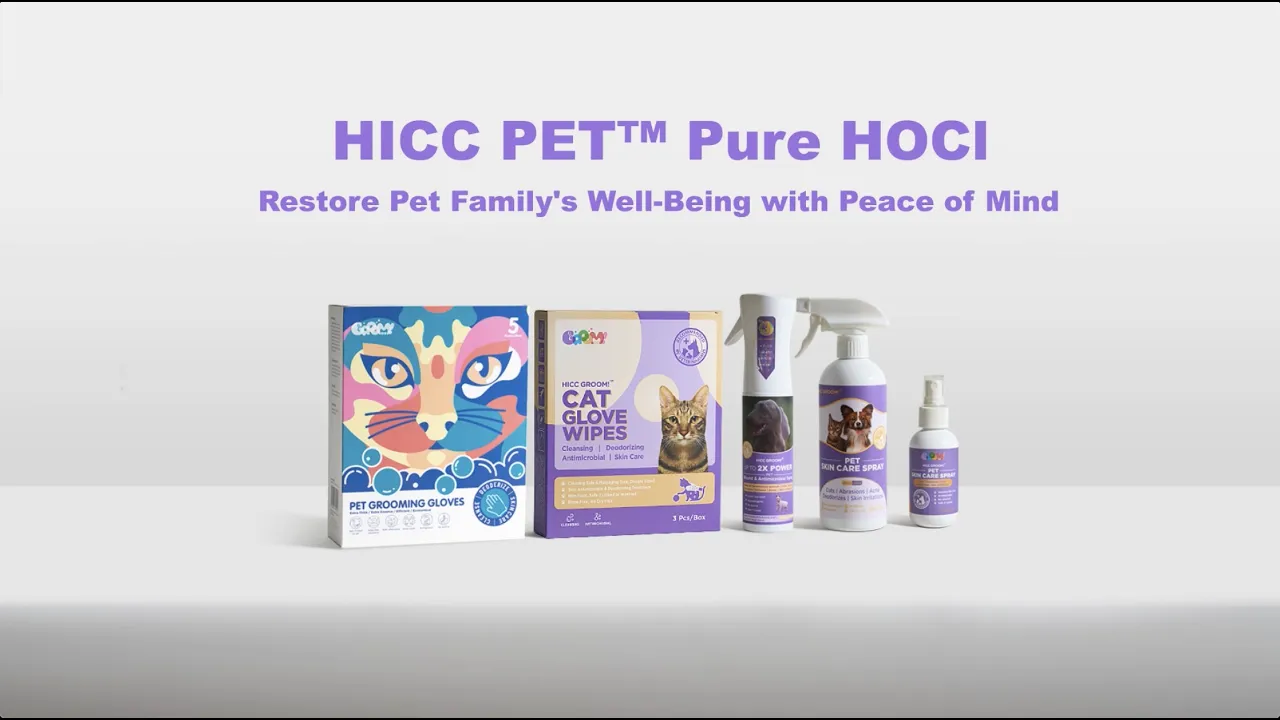

What Are The Clinical Benefits Of Using Purified Hypochlorous Acid On Pets?
Hypochlorous acid (HOCl) is a naturally occurring substance produced in mammalian white blood cells that aids the immune system in dealing with invading microbes.
Purified HOCl, formulated with our specialized technology, is a gentle cleanser that is soothing and non-irritating and is safe on the skin.
HICC Pet® HOCl is purified, stable, and formulated for optimal benefit.
What Makes HICC PET® Purified HOCl Technology Special?
Hypochlorous acid (HOCl) is a time-tested compound trusted for over a century for its remarkable properties. First recognized in veterinary science in 1916, it has long been valued for its reliability. We've harnessed this legacy using innovative stabilization technology to provide a purified, gentle yet effective formula without harmful additives. Our unique delivery systems, such as sprays, rinses, and gels, ensure HOCl remains in its most active, fresh state for your pet's care.

The Science Behind HICC PET® Purified Hypochlorous Acid Technology
The hypochlorous acid we created that is used in our products does not contain hypochlorite or synthetic ingredients. It is HICC Pet® patented scientific technology.
Our products contain:
NO Parabens
NO Propylene Glycol
NO Phthalates
NO Sulfates
NO Dyes
NO Harsh Chemicals
NO Alcohol
Ideal for Use on Pets

First Aid for the Skin

Gentle & Effective

Gentle Enough for Eyes and Ears

Refresh Your Pet's Environment

Scientific PublicationsBelow is a list of publications describing hypochlorous acid and its use in human and veterinary healthcare. It is provided for educational purposes only, and not to assert any type of healthcare claims for our products.
Andrés, CMC; Pérez de la Lastra, JM; Juan, CA; et al: Hypochlorous acid chemistry in mammalian cells – Influence on infection and role in various pathologies. Int J Mol Sci, 2022; 23(18): 10735; https://doi.org/10.3390/ijms231810735
Block, MS; Rowan, BG: Hypochlorous Acid: A Review. Journal of Oral and Maxillofacial Surgery, 2020; 78(9): 1461-1466. DOI: HYPERLINK "https://doi.org/10.3390/ijms231810735"10.3390/ijms231810735
Gold, MH, Andriessen, A; Bhatia, AC; et al: Topical stabilized hypochlorous acid: The future gold standard for wound care and scar management in dermatologic and plastic surgery procedures. J Cosmet Dermatol, 2020; 19(2): 270-277. https://doi.org/10.1111/jocd.13280
Jeffers, JG: Topical therapy for drug-resistant pyoderma in small animals. Vet Clin Sm Anim Pract, 2013; 43(1): 41-50, https://doi.org/10.1016/j.cvsm.2012.09.006
Joachim, D: Wound cleansing: Benefits of Hypochlorous acid. J Wound Care, 2020; 29(Sup10a): S4-S8. https://doi.org/10.12968/jowc.2020.29.Sup10a.S4
Mueller, RS; Baumann, KN; Boehm, T; et al: Evaluation of hypochlorous acid as an ear flush in dogs with chronic otitis externa. Vet Dermatol, 2023; 34: 134 –141. https://doi.org/10.1111/vde.13142
Natarelli, N; Nong, Y; Maloh, J; Sivamani, R: Hypochlorous Acid: Applications in Dermatology. Journal of Integrative Dermatology, 2022, published online. https://www.jintegrativederm.org/article/56663-hypochlorous-acid-applications-in-dermatology
Roberts, HL: Hypochlorous acid solution. An effective and inexpensive antiseptic preparation. Vet J, 1916; 72(7): 248-250.
Sakayra S, Gunay N, Karakulak M et al. Hypochlorous acid: an ideal wound care agent with powerful microbicidal, antibiofilm, and wound healing properties. Wounds. 2014;26(12):342–350.
Uri, M; Buckley, LM; Marriage, L; et al: A pilot study comparing in vitro efficacy of topical preparations against veterinary pathogens. Vet Dermatol, 2016; 27(3): 152-e39; https://doi.org/10.1111/vde.12306